A vacancy brief your team can actually use
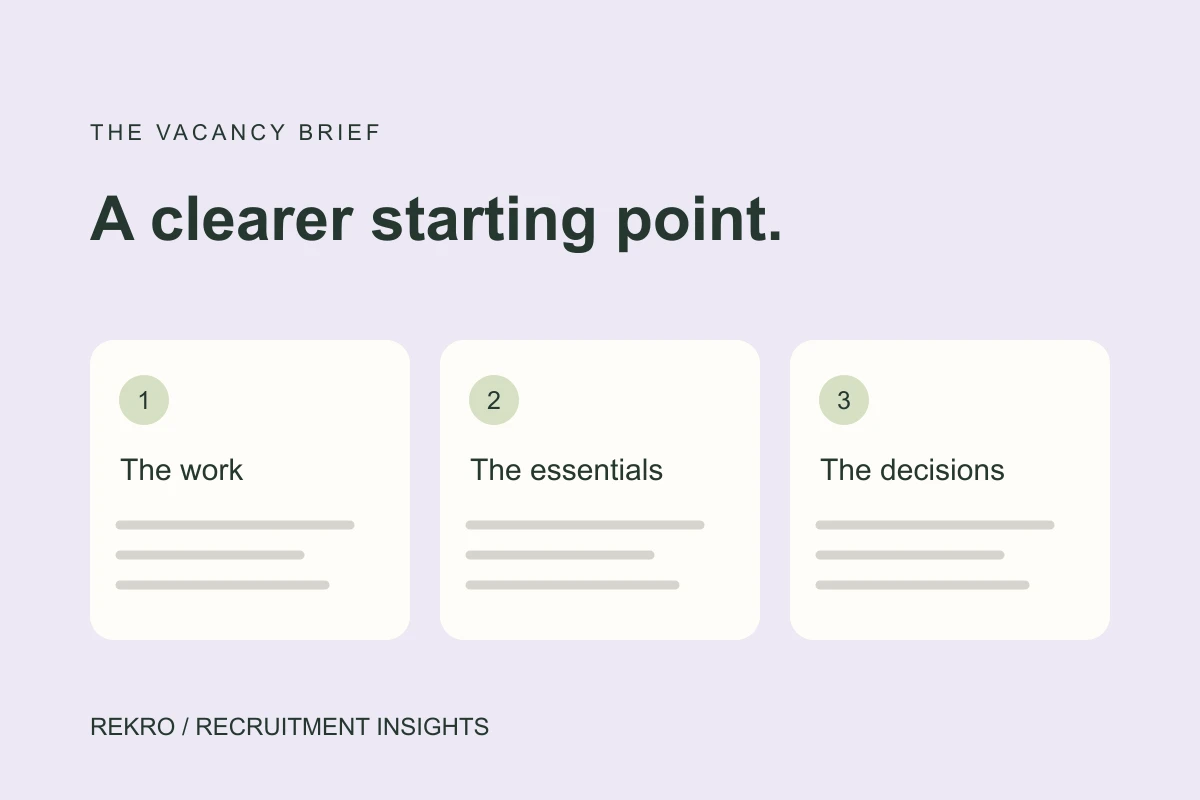
A better search starts with a shared understanding of the work, the essentials and the decisions still to be made.

Start with the work
A new vacancy often arrives as a familiar job title and a long list of requirements. That can be enough to start a search, but it leaves plenty of room for different interpretations. One consultant looks for sector experience, another prioritises technical skills, and the hiring manager has a particular problem in mind that never made it into the description.
Before opening the search, ask what the person will need to accomplish. What is waiting for them when they join? Which responsibilities will occupy most of their week? What would a successful first few months look like? These questions give the team something more useful than a collection of keywords.
For an operations coordinator, for example, the immediate priority might be keeping a busy scheduling process accurate while covering a colleague’s leave. That calls for a different conversation from a role focused on redesigning the process. The title can be the same while the work is quite different.
Separate essentials from preferences
Go through the requirements with the client and ask which ones are necessary from the start. Keep that list focused on the actual work. Then identify what could be learned with the support available and what would simply be useful to have.
If experience with a particular system appears on the list, ask what the person must do with it. A client may need someone who can produce a specific report immediately, or they may be comfortable with someone who has used a comparable tool. Those are different search criteria and should be recorded that way.
For each essential, agree what evidence would help assess it. A CV can open the conversation; a relevant example from the candidate can add detail. Give everyone reviewing the shortlist the same criteria so the decision does not drift towards whichever profile feels most familiar.
Resolve the practical questions early
Working arrangements can decide whether a role is suitable before anyone discusses experience. Confirm the location, expected days on site, working hours, salary or rate range, and intended start date. For temporary work, establish the expected duration as well.
Write down what is agreed and what is still open. “Flexible working” is too broad if the client means a choice of start time within an otherwise fixed office schedule. Describe the arrangement in terms a candidate can use to make a decision.
Where something needs approval, record who will confirm it and when. Recruiters should be able to explain the current position clearly without filling a gap with an optimistic assumption.
Agree how the shortlist will be judged
Before sending profiles, check who will review them and what they need to see. A short summary against the agreed essentials can help the client understand why each person is being introduced. Keep it specific to the candidate’s experience rather than repeating the vacancy description.
Use the first shortlist as a chance to check the brief together. If feedback introduces a new requirement, ask whether it changes the search. A preference that becomes essential halfway through needs an explicit decision, especially if it would rule out people already in the process.
Update the shared brief when that decision is made. Record the change and tell the colleagues working on the role, so the next search and the next candidate conversation start from the same information.
Put the brief where the team works
Rekro connects clients, contacts and vacancies, with notes and configurable fields to organise the detail around each role. That gives an agency a place to keep the agreed brief alongside the relationship and recruitment activity it belongs to.
Choose a small set of fields your team will keep current, then use the notes for context that needs more explanation. A compact, maintained record is easier to work from than a lengthy briefing document that no longer reflects the client’s decisions.
For the next role you take on, finish the briefing with a simple read-back: here is the work, here are the essentials, and here is what we still need to confirm. If the client and the consultant agree on those three things, the search has a useful starting point.