Get the first day ready before Monday
An accepted assignment still needs a workable start. Check the details that help a contractor arrive ready and a client welcome them properly.

Look beyond the start date
A contractor has accepted the assignment and the start date is in the diary. It is tempting to treat the placement as ready and move on to the next vacancy. But the contractor still needs to know where to go, the client needs to be ready to receive them, and someone needs to resolve anything outstanding.
First-day preparation is a useful discipline for temporary and contract desks. It brings together the small practical details that can otherwise remain scattered across calls and emails. The aim is straightforward: a person starting work should not have to spend the morning discovering who expected them.
For Monday starts, review the arrangements before the working week closes. For shifts and other start patterns, choose a checkpoint that leaves enough time to reach the people who can solve a problem.
Make arrival instructions usable
Check the exact address or remote joining instructions, the arrival time and the name of the person meeting the contractor. A large client may have several entrances, sites or teams. The organisation’s main address is not always the place someone should report to.
Ask the client to confirm any practical instructions the contractor needs in advance, such as reception arrangements, equipment to bring or the plan for the first hour. Keep the message short enough to find and use on the morning itself.
Invite the contractor to flag anything unclear. A reply confirming the location and time is more useful than assuming that sending a message has settled the arrangements. If the client changes the plan, check that the contractor has received the updated version.
Check that the client is ready too
The hiring contact may have agreed the start without arranging every detail locally. Confirm that the person welcoming the contractor knows they are coming and that the team has a first task or introduction planned.
For a remote assignment, ask who is arranging equipment and access, and how the contractor should make contact if they cannot join. Keep passwords and other sensitive access details out of general placement notes; the client should use its appropriate access process.
A useful question is: “If the contractor arrives at the agreed time, what happens next?” If the answer depends on someone who is away or an arrangement nobody has confirmed, there is still work to do.
Keep open tasks visible
Review the assignment details and any outstanding checks with the colleagues responsible. Distinguish between information that has been requested, information that has arrived and a review that has been completed. Those stages should not be treated as interchangeable.
Give each unresolved item a named owner and a time for the next decision. Where an outstanding requirement affects whether the assignment can begin, ask the responsible person to confirm the position before telling the contractor that everything is ready.
If the start needs to move, coordinate with the client and contractor promptly. Update the assignment record once the new arrangement is agreed, and check that any earlier arrival instructions are replaced. A revised date in one record does not mean everyone has seen it.
Plan a short first-day check-in
Agree who the contractor should contact if there is a problem on arrival and who will be available at that time. A general office number offers little reassurance for an early shift if nobody answers it until later.
Once the assignment has begun, make a brief check-in part of the routine. Has the contractor met the right person? Can they access what they need? Does the work match the arrangement discussed? Direct any issue to someone who can act, and record the next step.
The check-in need not become a long questionnaire. Its purpose is to catch a practical problem while there is still time to help with the first working day.
Keep preparation connected to the assignment
Rekro links contractor assignments to the candidate, vacancy and client, with dates and agreed terms on the assignment record. Saved views and configurable workflows can help the team organise upcoming work and keep its preparation routine close to the placement.
The platform gives those records a shared home; the agency and client still need to confirm the actual arrangements. Use the assignment as the starting point for a review, then make sure the contractor receives clear instructions through the agreed communication channel.
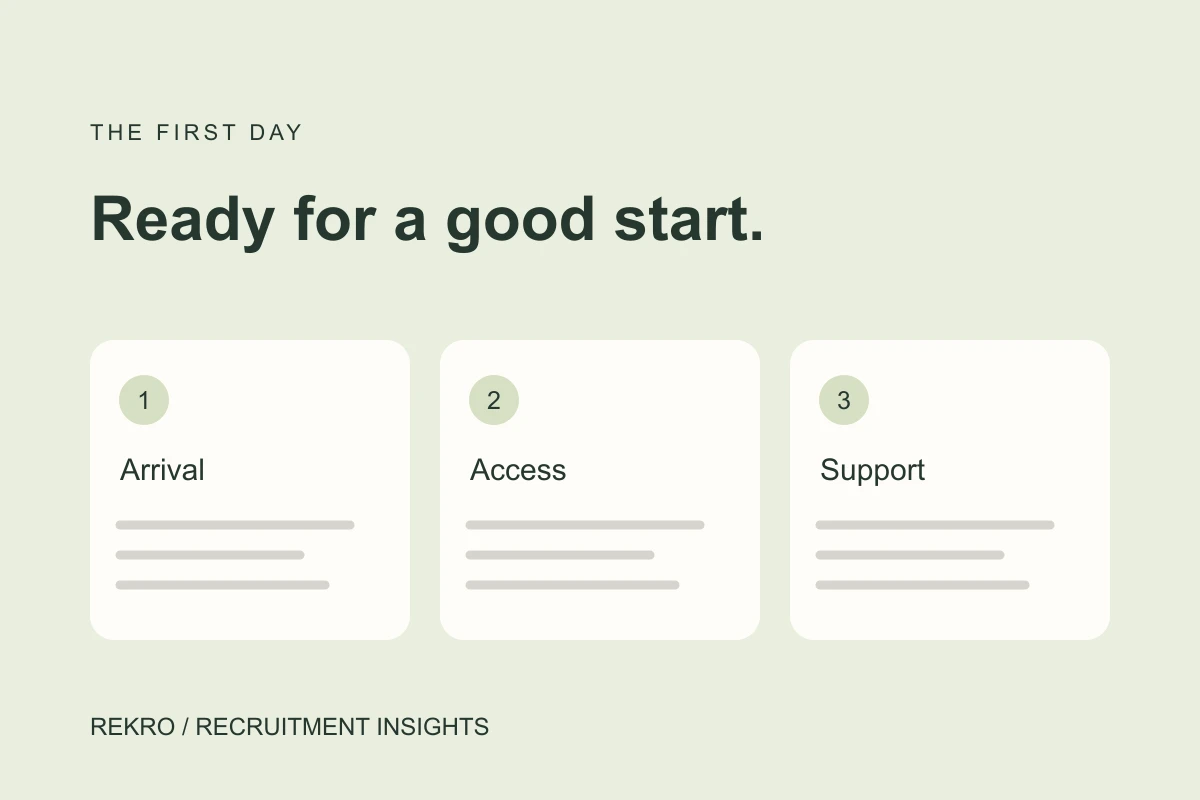
Before your next start, check three things together: the contractor knows how to arrive, the client knows how to receive them, and every open task has someone responsible for it. That is a practical foundation for a settled first day.